Crest ConcreteSacramento · Referral service

Sacramento · Placer · El Dorado · Yolo

Concrete Contractors in Sacramento, CA

Sacramento Crest Concrete connects Sacramento-area homeowners with independent, CSLB-licensed concrete contractors for driveways, stamped concrete, patios, slabs, walkways, steps and repairs. Send one request describing the job and we pass your contact information to contractors who work in your area. A contractor can visit to measure and quote, and you contract with and pay that contractor directly. This page covers what the work involves in the valley and foothills: soil, heat, curing, permits, typical national costs and how to hire well.

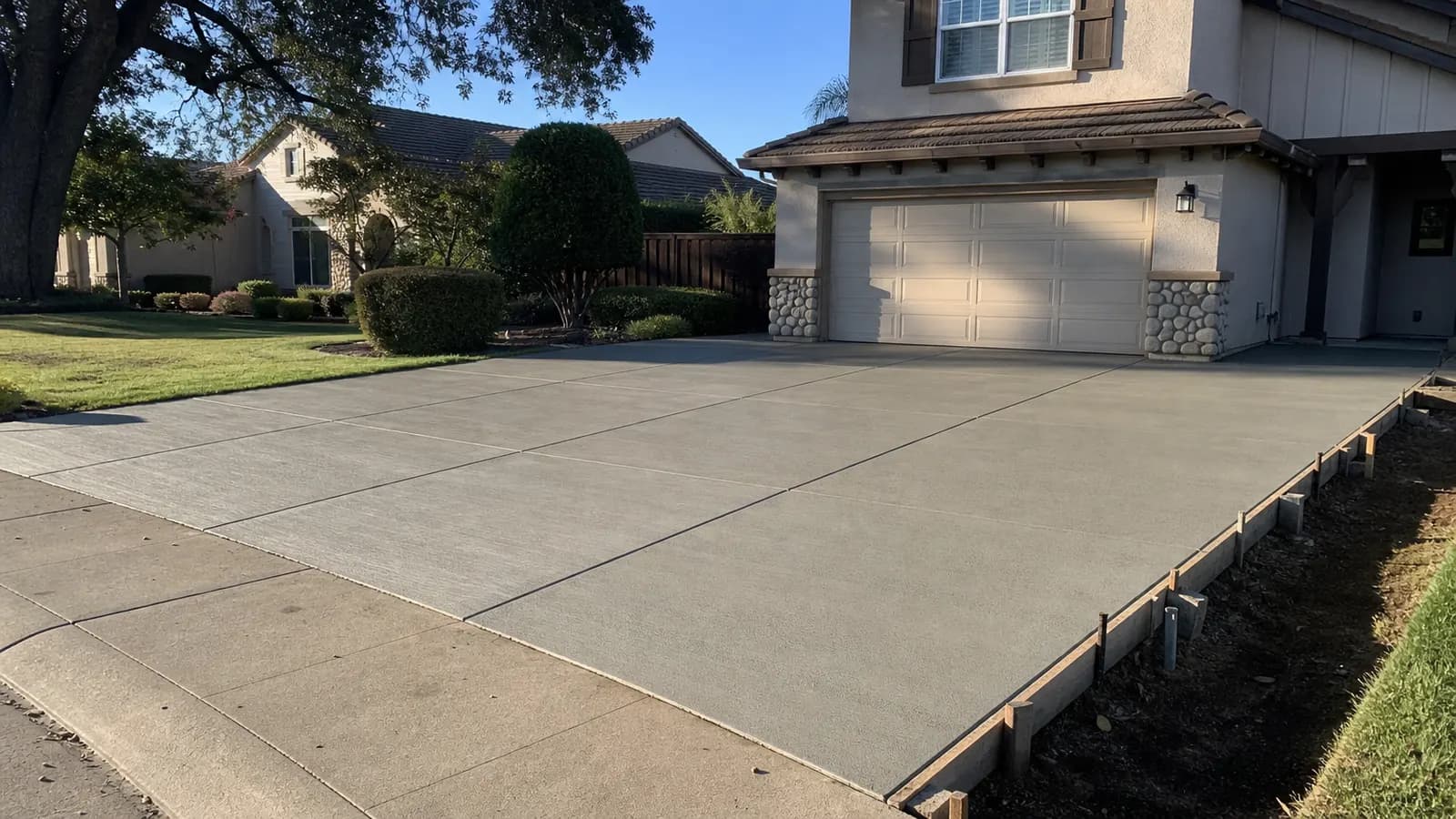
Freshly poured light gray broom-finish concrete driveway in front of a two-story stucco tract home, with saw-cut control joints, form boards along one edge and a valley oak behind
Request ticketReferral
Request cost
$0
Coverage
Greater Sacramento
Contractors
Independent, CSLB-licensed
You contract with
The contractor, directly
Driveway slab
4 in min.
Control joints
8–12 ft on 4 in
Moist cure
≈7 days
Flatwork permit
Usually exempt ≤30 in

Concrete Driveways in Sacramento

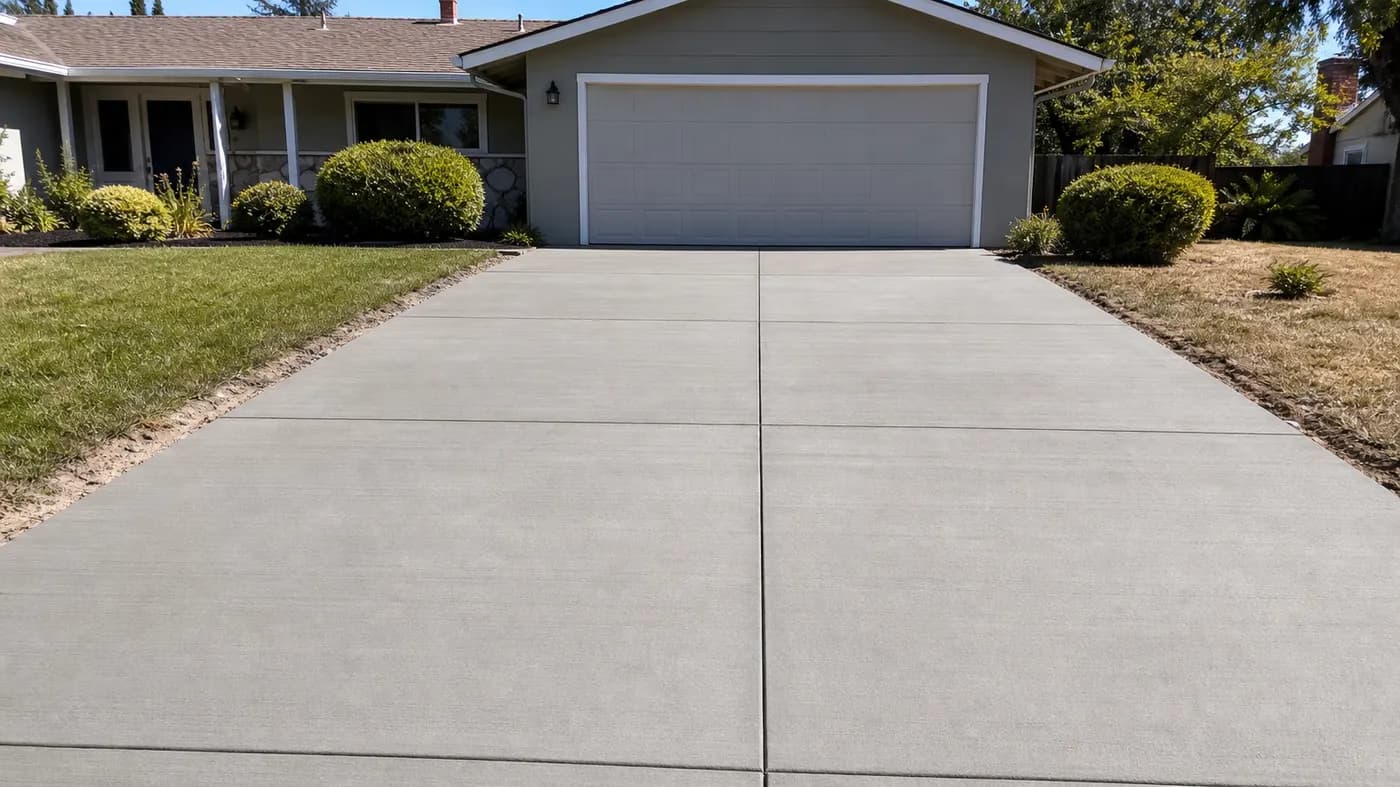
The driveway is the job most homeowners start with, and the specification is simple. A residential driveway for passenger vehicles is a minimum of 4 inches thick, usually in concrete of about 3,500–4,000 psi, with saw-cut control joints and a broom finish for traction. Joints are spaced about 24–36 times the slab thickness in inches, so a 4-inch slab gets a joint roughly every 8–12 feet, cut at least a quarter of the thickness deep. Joints do not prevent cracking. They tell the concrete where to crack.

Most of what separates a driveway that lasts from one that does not is under the surface: how the subgrade was graded and compacted, whether base rock was added and how the concrete was cured. Read the full guide to concrete driveways for the details, including approach width rules in the City of Sacramento and what to ask about thickness, strength and joints.

Plain, broom-finish or exposed aggregate

Plain gray concrete with a broom finish is the standard and the least expensive option. Exposed aggregate washes the surface cement away to show the stone, and it adds about $3–$8 per sq ft. Stamped or colored finishes cost more again. A light-colored driveway reflects heat, which matters on a south-facing lot in July, and it shows oil and tire marks more than a darker mix does.

What to ask before the pour

  • How thick will the slab be, and what strength of concrete is specified?
  • How will the base be graded, compacted and, if needed, built up with rock?
  • Where will the control joints go, and will they be saw-cut?
  • Is old concrete coming out first, and is that priced separately?
  • Who handles any permit for the street-side approach?

Stamped and Decorative Concrete

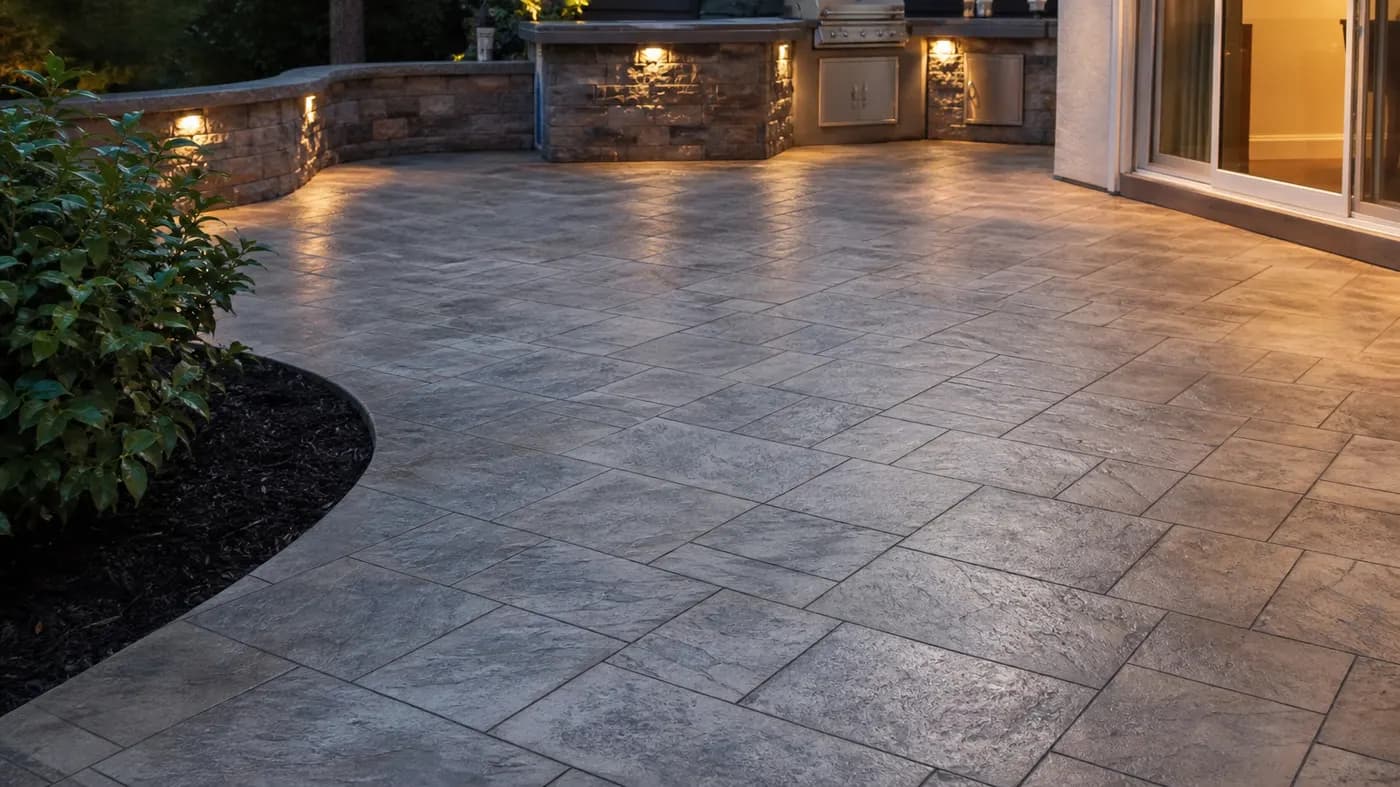
Stamped concrete is poured, colored and imprinted with patterns to look like slate, stone, brick or wood. Roman slate and ashlar patterns are common. Color can be mixed into the concrete, broadcast over the surface as a hardener, or applied as an antiquing release that leaves darker tones in the grooves. A sealer finishes the job and protects the color.

Stamped work typically runs $12–$25 per sq ft installed nationally, roughly double a plain slab, because it takes more labor, more materials and more skill under time pressure. Sacramento's heat makes timing important: stamping has to happen in a narrow window after the pour. Related options include decorative concrete such as acid staining and scored borders, and exposed aggregate, which adds about $3–$8 per sq ft over a plain surface. Colored concrete adds about $2–$6 per sq ft.

Where stamped concrete is used

Patios are the most common place for it, followed by pool decks, walkways, front entries and the occasional driveway. Stamped patterns hide small surface cracks better than plain concrete, but they do not prevent cracking, and they need the same joints, base prep and curing as any slab. Resealing every few years keeps the color from fading in the sun.

Concrete Patios and Slabs

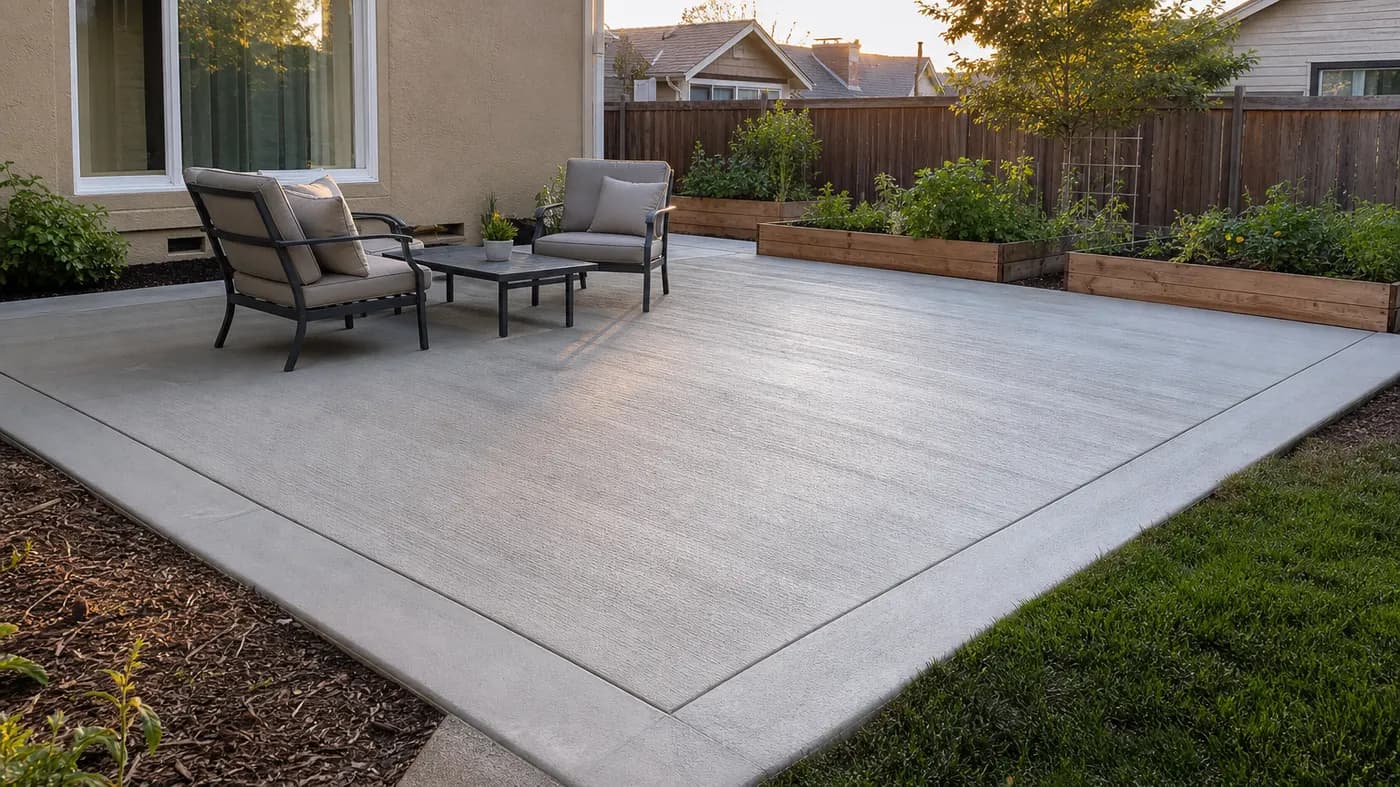
A concrete patio is the other job homeowners ask about most. Plain broom-finish patios are the baseline. A trowel-edged border with a broom center, color, a stamped pattern or a saw-cut grid raises the price and the polish. Typical national installed ranges run $5–$18 per sq ft, from plain to custom. Plan drainage first: a patio should slope away from the house, usually by a small amount, and not trap water against the foundation or stucco.

Slabs for sheds, equipment, hot tubs and garage additions follow the same logic with fewer finish choices. Typical national ranges are $4–$12 per sq ft. See the guides on concrete slabs and slab cost for sizes, thickness and examples. Small pads often cost more per square foot than large ones because the contractor's fixed costs are spread over less area.

Sizing and layout

Patio size drives the budget more than finish does. A 12 by 16 foot patio is 192 square feet. At the typical national range of $5–$18 per sq ft, that is roughly $960–$3,456, and the real number depends on prep, finish and access. Think about furniture, a grill and a path from the back door before you settle on dimensions, because it is cheaper to pour it larger once than to extend a slab later.

What Concrete Costs in Sacramento

No source we could verify publishes Sacramento-specific concrete prices, so these are typical national ranges per square foot. They are installed prices, and they are a way to sanity-check a quote, not a price. The Sacramento concrete cost guide explains what moves a quote up or down.

JobTypical national range
Plain or broom-finish driveway$6–$12 per sq ft
Stamped concrete$12–$25 per sq ft
Patio, plain to custom$5–$18 per sq ft
Sidewalk or walkway$6–$14 per sq ft
Concrete slab$4–$12 per sq ft
Removal of old concrete$2–$6 per sq ft
Resurfacing or overlay$3–$9 per sq ft

The things that move price most are thickness, base prep on clay or hardpan, access for equipment, removal of old concrete, finish and any permit for a street-side approach. Compare quotes that cover the same scope, line by line.

Sacramento Soil and Subgrade

Concrete is only as stable as what it sits on. Sacramento County has widespread restrictive soil layers: a cemented hardpan a few feet below the surface, claypans in older terrace soils, and series such as San Joaquin and Redding that the county describes as having high shrink-swell potential. Clay swells when wet and shrinks as it dries, and that movement can crack and tilt slabs. Expansive clay and hardpan are common, so subgrade preparation matters.

In practice that means grading and compacting the subgrade, adding base rock where the contractor recommends it, and keeping irrigation and downspouts from soaking the ground beside a slab. Foothill soils in El Dorado Hills, eastern Folsom and Granite Bay are often clay, decomposed granite or shallow and rocky, so the prep there is different from the flat valley floor. A contractor who has walked your lot can say what it needs.

Valley floor and foothills

Elk Grove is one place where a subsurface hardpan layer has been noted in city planning documents. Mehrten Formation clays near Folsom can swell by about 4 percent by volume. The practical takeaway is not a rule, only a question: ask the contractor what they know about the soil at your address and how that shapes their base prep. A drainage plan that moves water away from the slab and the house is as important as the concrete.

Heat, Curing and Pour Timing

Sacramento's normal July high is about 93–94°F, with about 20+ days a year at 100°F or hotter, and annual rainfall is about 18.5 inches. Hot, dry air speeds hydration and pulls water out of fresh concrete before it can gain strength. That shows up as plastic shrinkage cracks, a weak surface and finishing that gets away from the crew.

Contractors manage it with early starts, shaded or dampened subgrade and by keeping the slab continuously moist for about 7 days, covered with damp burlap or curing blankets in sun and wind. Moist-cured concrete is substantially stronger at 7 days than uncured. Ask what the curing plan is. Also ask how soon you can walk on the slab and when cars can use it, since specific timing depends on the mix and the weather.

Summer pours

The area logged a record 45 days at 100°F or hotter in 2024. In a summer like that, a pour scheduled for the afternoon is a risk. Many contractors start at dawn or move jobs to cooler weeks, and a good one will tell you why. Rain is a different issue: city rules like Roseville's right-of-way permit conditions say there is no pouring or finishing in rain.
Permits for Concrete Work

California's building code exempts sidewalks and driveways not more than 30 inches above adjacent grade (not over a basement or story below and not part of an accessible route) from a building permit. Roseville and Citrus Heights publish that exemption, and other cities generally follow the same code. Exempt work still has to meet code and setback rules, and a patio is not named in the code list, so confirm with your city or county.

The street-side approach is the exception. In the City of Sacramento, a new or modified driveway that needs a curb cut requires a driveway permit, while a driveway that abuts a rolled (mountable) curb or an alley does not. Single-car driveways are 10–12 feet wide and two-car up to 20 feet. In unincorporated Sacramento County, approaches in the county right-of-way need a SacDOT encroachment permit. Contractors usually handle the paperwork. Ask who does.

Rules differ by jurisdiction

The City of Sacramento, unincorporated Sacramento County (Carmichael, Fair Oaks, Antelope, Orangevale and others), Elk Grove, Roseville, Folsom, Citrus Heights and the Placer, El Dorado and Yolo County cities each run their own permit counters. Citrus Heights notes that exempt work may still be subject to planning setback standards. In the City of Sacramento, driveway permit packages include a site plan, a traffic control plan and proof of liability insurance, and work may begin only after the permit is issued. Confirm with your city or county before work starts.

Repair, Replacement and Leveling

Not every problem needs new concrete. Concrete repair covers patching, crack filling and spalled surfaces on slabs that are otherwise sound. Concrete leveling, also called mudjacking, raises a sunken slab by pumping material under it, typically $3–$8 per sq ft nationally. Resurfacing puts a thin overlay over a worn but sound slab, typically $3–$9 per sq ft.

When a slab is broken into many pieces or has settled badly, replacement is cleaner. Removal typically runs $2–$6 per sq ft before the new pour. See driveway replacement and concrete removal. Sealing the finished slab, at about $1.35–$2.50 per sq ft with labor, helps protect it. See concrete sealing.

Repair, resurface, level or replace?

ProblemUsual first option
Hairline or stable cracks, small chipsRepair and seal
Worn, stained or scaled surface on a sound slabResurfacing
One or two slabs sunken or tiltedLeveling
Many broken pieces, wide moving cracks, repeated settlingRemoval and replacement

A contractor who looks at the slab in person can tell you which of these fits. Be wary of any answer that is always the same, whichever slab it is.

Retaining Walls and Foundations

Foothill and sloped lots often call for retaining walls, poured or built from segmental block, with drainage gravel behind the wall. Concrete retaining walls typically run $20–$60 per sq ft of wall face nationally. California's code generally exempts walls not over 4 feet (measured from the bottom of the footing to the top of the wall) from a building permit, unless they support a surcharge. Unincorporated Sacramento County may apply a stricter rule, so check before building.

Footings, stem walls and slab foundations for additions and outbuildings are a separate, more engineered job. See concrete foundations. For walls and foundations, ask the contractor which license classification covers the work and confirm it at cslb.ca.gov.

Drainage decides whether a wall lasts

Water behind a wall is what pushes it over. Gravel backfill and a drain at the base are standard on foothill backyard walls, and a wall that is tiered into a slope is often easier to build and to permit than one tall wall. Ask where the water goes, what the footing sits on, and whether the wall is under or over the 4 foot threshold where permit rules change.

Hiring a Licensed Concrete Contractor, and How Sacramento Crest Concrete Works

In California, concrete flatwork is typically done under a C-8 Concrete license. The classification covers forming, pouring, placing and finishing mass, pavement and flat concrete work. Earthwork and paving fall under C-12. Check any license at cslb.ca.gov before you sign. A contractor's license number must appear in their advertising and on their proposals.

  • A home improvement down payment may not exceed $1,000 or 10 percent of the contract, whichever is less.
  • You have three business days to cancel a home improvement contract in most cases (five if you are 65 or older).
  • Get the scope, thickness, base prep, joints, finish, sealer, permits and cleanup in writing.
  • Compare at least two quotes on the same scope.

Sacramento Crest Concrete is a referral service, not a contractor. It does not pour, repair, quote or warranty anything. California allows referral services within limits: they may pass contact information to licensed contractors, but may not negotiate contracts or purport to do the work. So you send a request, we pass your information to licensed contractors who work in your area, and you contract with and pay the contractor you choose directly. See the FAQ for more on how it works.

Request · no cost

Ready to pour? Get connected with a contractor.

Tell us your city, the job (driveway, patio, slab, repair) and a rough size. We pass it to an independent, CSLB-licensed concrete contractor who serves your area. They contact you to look at the site and give you a written quote; you contract with them directly.

  1. 01Your request goes to a contractor who serves your city.
  2. 02They call or email to see the site and quote in writing.
  3. 03You decide. Contract and pay the contractor directly.
Call (916) 270-6721

Request a concrete contractor

We share your request with an independent, licensed concrete contractor who serves your area so they can contact you about your project. See our privacy policy.

FAQ

Concrete Questions From Sacramento Homeowners

Q01

How do I find a concrete contractor in Sacramento?

Send a request describing the job. Sacramento Crest Concrete passes your contact information to independent, licensed concrete contractors who work in your area, and you choose who to hire. Requests cost nothing.

Q02

Is Sacramento Crest Concrete a contractor?

No. It is a referral service. It does not pour, repair, quote or warranty any work, and you contract with and pay the contractor directly.

Q03

How much does a concrete driveway cost?

Typical national ranges are $6–$12 per sq ft for a plain broom-finish driveway and $12–$25 for stamped concrete. Sacramento prices come from local quotes.

Q04

How thick should a concrete driveway be?

Four inches is the minimum for passenger vehicles. Your contractor can recommend more depending on use and soil.

Q05

Do I need a permit to pour a driveway or patio?

Flatwork not more than 30 inches above grade is usually exempt from a building permit, but a driveway approach in the street right-of-way often needs an encroachment or driveway permit. Confirm with your city or county.

Q06

What license should a concrete contractor have?

Concrete flatwork is typically done under a C-8 Concrete license. Verify the license at cslb.ca.gov before you sign.

Q07

How long does concrete take to cure?

Keep it continuously moist for about 7 days, shielded from sun and wind in hot weather. Ask your contractor when you can walk or drive on it.

(916) 270-6721Request